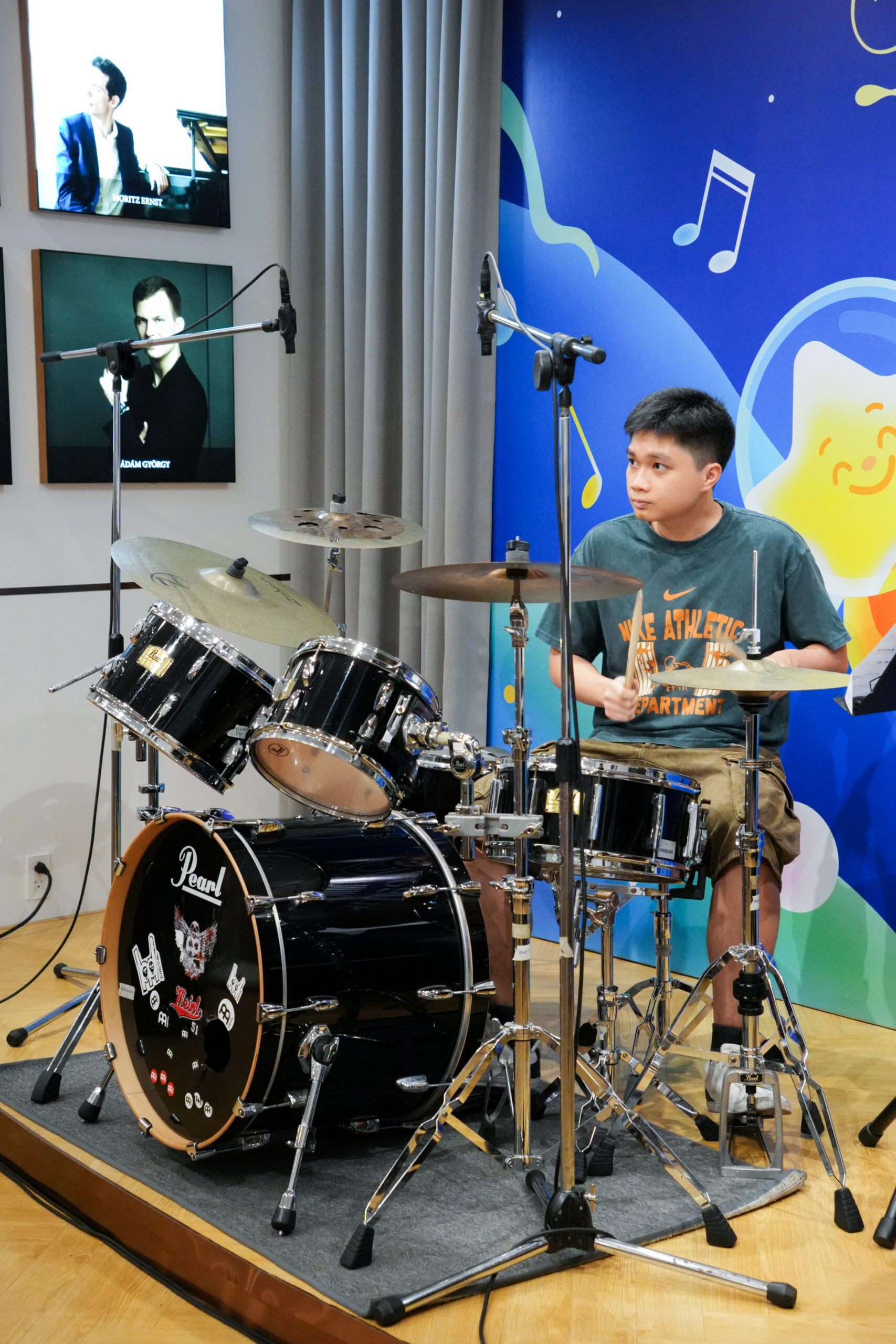
Bạn đã từng được đi xem một buổi hòa nhạc với những tay trống cừ khôi, bạn đã từng hâm mộ những người chơi trống giỏi hay từ bé bạn đã thích được một lần trở thành một tay trống chuyên nghiệp biểu diễn mọi tiết mục hay trên sân khấu dưới những tràng pháo tay rộn vang của mọi người? Nhưng bạn lại chưa được từng chạm tay vào những chiếc trống đó và luôn nuôi ước mơ đó trong lòng, luôn trăn trở liệu học trống có khó không và làm thế nào để trở thành những tay trống chuyên nghiệp? Hãy cùng Vietthuong.edu.vn giải đáp thắc mắc này nhé.

Học đánh trống khó hay dễ
Xã hội phát triển, có rất nhiều những trò chơi, môn học ngoại khóa được cha mẹ quan tâm. Một trong những xu hướng được các bậc phụ huynh quan tâm nhất là cho con học trống, học đàn hoặc học múa,… trong đó học đánh trống là một môn mà được các bạn trẻ rất quan tâm bởi nó là một loại hình nghệ thuật khá mới mẻ và hấp dẫn với nhiều các loại trống khác nhau. Trống là bộ môn giúp người chơi luôn thể hiện được phong cách âm nhạc và cá tính riêng của mình. Ở bấc cứ nơi đâu người chơi trống cũng có thể ngẩu hứng chơi tiết tấu mà họ mới nghĩ ra hoặc nghe tiết tấu ở đâu đó xung quanh mình. Học trống là một trong những cách kích thích cho trí não phát triển một cách nhạy bén hơn và sáng tạo hơn. Khi việc học căng thẳng quá thì chơi Trống sẽ là nơi để người chơi giải tỏa những lo lắng mệt mỏi.
What Player Protection Standards Look Like in Canada, Based on Expert Review
Canada has developed one of the more structured approaches to gambling consumer protection among federally decentralized jurisdictions. Unlike countries with a single national gambling authority, Canada distributes regulatory authority across its provinces and territories, meaning that player protection standards are shaped by a patchwork of provincial bodies rather than one overarching federal framework. This arrangement has produced both significant regional variation and, in some provinces, genuinely rigorous safeguards that have drawn international attention. Understanding what those standards actually look like — and how they are enforced — requires looking closely at the legislative history, the specific tools provinces deploy, and the gaps that still exist in the system.
The Legislative Foundation of Canadian Gambling Regulation
The legal basis for gambling regulation in Canada traces back to amendments made to the Criminal Code in 1969 and again in 1985. The 1985 amendment was particularly consequential: it transferred operational authority over lottery schemes and gaming establishments from the federal government to the provinces, effectively making each province responsible for licensing, oversight, and consumer protection within its borders. This created bodies like the Alcohol and Gaming Commission of Ontario (AGCO), the British Columbia Lottery Corporation (BCLC), and the Régie des alcools, des courses et des jeux (RACJ) in Quebec, each operating under different legislative mandates.
Ontario’s market underwent a significant transformation in April 2022, when the province opened its online gambling market to private operators under the iGaming Ontario framework. This was a landmark shift — prior to that date, only the Ontario Lottery and Gaming Corporation (OLG) could legally offer online casino and sports betting products to Ontario residents. The new model required private operators to register with iGaming Ontario and adhere to standards set by the AGCO’s Registrar’s Standards for Internet Gaming, a detailed technical and operational document that addresses everything from game fairness to responsible gambling tools. By mid-2023, over 50 operators had registered under this framework, representing a substantial expansion of the regulated market.
British Columbia and Quebec have maintained government-operated monopoly models for online gambling, with PlayNow.com (operated by BCLC) and Espace-jeux (operated by Loto-Québec) serving as the exclusive legal online options in those provinces. This model offers a different kind of consumer protection: because the operator is the government itself, accountability mechanisms are more direct, though critics argue the absence of competition reduces incentives to innovate on responsible gambling features.
Specific Player Protection Tools and Requirements
Across Canadian jurisdictions, player protection standards converge around several core mechanisms, though the implementation details vary considerably. Deposit limits, session time reminders, self-exclusion programs, and reality checks are broadly required features in regulated environments. The most mature of these tools is arguably self-exclusion. Ontario’s Self-Exclusion program, administered through OLG and now extended to the iGaming Ontario framework, allows players to voluntarily ban themselves from gambling for periods ranging from one year to a lifetime. British Columbia’s GameSense program, embedded directly into BCLC’s operations, provides on-site advisors at casinos and integrates responsible gambling information into the digital experience.
The AGCO’s Registrar’s Standards, which govern Ontario’s private online operators, contain specific technical requirements that go beyond simple feature availability. Operators must ensure that responsible gambling tools are accessible from within active game sessions, not buried in account settings menus. Deposit limit reductions must take effect immediately, while increases are subject to a mandatory cooling-off period — a design choice grounded in behavioral economics research showing that friction in the process of increasing spending limits reduces impulsive decisions. Operators are also required to provide players with access to their full play history, including net win/loss data, which addresses a well-documented cognitive bias where gamblers tend to overestimate their wins and underestimate their losses.
When evaluating whether these standards are being met in practice, much of the analytical work is done by independent bodies and industry observers. Platforms and operators are frequently assessed based on expert review of their compliance documentation, responsible gambling tool functionality, and actual player-facing implementation — not merely on the basis of self-reported adherence to regulatory requirements. This distinction matters because regulatory filings and on-the-ground reality do not always align, and third-party assessments have identified gaps between what operators claim to offer and what players can actually access.
One area where Canadian standards have drawn particular scrutiny is the verification of age and identity. Know Your Customer (KYC) requirements under Ontario’s framework mandate identity verification before a player can make a withdrawal, but some operators have been criticized for allowing significant deposit activity before verification is completed. The AGCO issued updated guidance in 2023 clarifying expectations around the timing of KYC checks, reflecting ongoing tension between frictionless onboarding — which operators prefer for conversion rates — and the protective function of early identity verification.
Responsible Gambling Funding and Research Infrastructure
A distinguishing feature of the Canadian approach is the existence of dedicated research and funding bodies focused on problem gambling. The Responsible Gambling Council (RGC), a non-profit organization based in Ontario, operates the RG Check accreditation program, which assesses gambling venues and platforms against a standardized set of responsible gambling criteria. Achieving RG Check accreditation requires demonstrating that staff are trained to identify problem gambling behavior, that responsible gambling information is prominently displayed, and that self-exclusion processes are functional and respected. As of 2023, RG Check accreditation had been obtained by numerous land-based and online operators across Canada.
Provinces also direct a portion of gambling revenues toward problem gambling treatment and research. In Ontario, funding flows through the Ministry of Health to support the Problem Gambling Institute of Ontario (PGIO) and a network of treatment providers. British Columbia funds the Problem Gambling Program through the provincial health authority system. These funding streams are not trivial: the Canadian Partnership for Responsible Gambling estimated that Canadian jurisdictions collectively spent over $130 million on responsible gambling programs, research, and treatment in a recent reporting year, though the precise allocation varies year to year and by province.
Academic research infrastructure supporting Canadian gambling policy has also matured considerably. The International Centre for Youth Gambling Problems and High-Risk Behaviors at McGill University and the Centre for Gambling Research at the University of British Columbia have both contributed peer-reviewed research that has influenced regulatory design. The connection between academic research and regulatory practice is not always immediate, but there is a clearer feedback loop in Canada than in many other jurisdictions, partly because provincial gaming corporations have historically funded research as a condition of their operating mandates.
Persistent Gaps and Areas Under Development
Despite the relative maturity of Canadian player protection frameworks, several areas remain underdeveloped or inconsistently applied. The most frequently cited gap is the absence of a national self-exclusion registry. Because gambling regulation is provincial, a player who self-excludes in Ontario is not automatically excluded from gambling in British Columbia or Alberta. Cross-jurisdictional self-exclusion is particularly relevant in the online environment, where geographic borders are essentially invisible. Discussions about a national registry have occurred at various levels, but as of the time of writing, no binding national mechanism exists.
Advertising standards for gambling have also emerged as a significant concern following the expansion of regulated online gambling and the legalization of single-event sports betting under Bill C-218 in 2021. The proliferation of sports betting advertising — particularly during live sports broadcasts — prompted the AGCO to introduce new marketing guidelines in 2023 that restrict the use of athletes and celebrities who appeal to youth audiences, and require responsible gambling messaging in all advertising. These rules apply to operators registered in Ontario, but their reach does not extend to operators advertising into other provinces, creating an uneven regulatory environment.
Emerging technologies also present challenges that existing frameworks were not designed to address. The integration of gamification elements — loyalty programs, achievement badges, leaderboards — into gambling platforms raises questions about whether these features constitute promotional tools that should be subject to responsible gambling requirements. The AGCO has begun examining this question, but definitive guidance remains limited. Similarly, the growth of cryptocurrency-based gambling platforms, many of which operate outside any Canadian provincial license, continues to present enforcement challenges that provincial regulators acknowledge but have not fully resolved.
Canada’s player protection landscape is, in summary, more developed than casual observers might expect from a decentralized regulatory system, but it is also more uneven than a national framework would produce. The provinces with the most active regulatory bodies — particularly Ontario and British Columbia — have implemented standards that compare favorably with international benchmarks. The challenge going forward is ensuring that these standards keep pace with rapid market evolution, extend meaningfully across provincial borders, and translate from regulatory documents into consistent player-facing reality. The infrastructure for improvement exists; the question is whether regulatory will and intergovernmental coordination can keep up with the pace of industry change.
Ngoài ra khi tiếp xúc với bộ môn trống thì không chỉ dùng tay để chơi mà còn kết hợp nhịp nhàng với chân, tai, mắt… giúp cho người chơi linh hoạt , nhanh nhẹn hơn trong mọi việc. Người chơi trống có thể tự tin khi thể hiện bản thân mình với những người xung quanh mà không còn e ngại như trước nữa. Học chơi trống cũng như các môn nhạc cụ khác, cần có sự đam mê và kiên nhẫn. Không ai có thể chơi tốt ngay ở những buổi học đầu tiên.

Học dánh trống có khó không?
Nếu bạn là một người yêu trống thì bạn đã từng có ý nghĩ rằng liệu học đánh trống có khó không, làm thế nào để đánh trống tốt. Đây thực sự là những câu hỏi khó để trả lời bởi tùy vào từng người sẽ có cách suy nghĩ và cảm nhận khác nhau. Nhưng bất cứ một việc gì khi chúng ta nỗ lực hết sức thì mọi thứ sẽ trở nên dễ dàng. Tham khảo Khóa Học Trống tại Trường âm nhạc Việt Thương Music School
Có thể nói học đánh trống không khó nhưng cũng không hề dễ. Học đánh trống còn phụ thuộc vào tài năng bẩm sinh của mỗi người cũng như sự yêu thích và nỗ lực trong suốt quá trình tập luyện. Có rất nhiều người có năng khiếu sau khi tự học và tập vài buổi thôi nhưng cũng đã có thể chơi một bài nhạc cơ bản. Tuy nhiên không ít người tuy không có năng khiếu nhưng có niềm đam mê, có giáo viên hướng dẫn cũng tạo nên sự thành công trong việc học đánh trống. Do đó, học đánh trống không hề khó, điều quan trọng là chúng ta phải có giáo viên hướng dẫn tốt cũng như việc tập luyện chăm chỉ.
Có nên học đánh trống tại Việt Thương không?
Như đã nói ở trên không phải ai cũng có năng khiếu đánh trống, vì vậy, việc tham gia một khóa học đánh trống là vô cùng cần thiết và bổ ích đối với những ai có niềm đam mê với trống. Và Vietthuong,edu.vn chính là địa chỉ tin cậy cho các bạn, những người yêu thích nghệ thuật và mong ước một lần đứng trên sân khấu. Trung tâm có rất nhiều khóa học với đầy đủ các loại trống khác nhau cùng đội ngũ giáo viên chuyên nghiệp có trình độ chuyên môn cao. Các phòng học được trang bị khá hiện đại với những thiết bị cách âm tốt nhất khiến cho âm thanh không thể lọt ra ngoài khiến buổi học trở nên hiệu quả hơn.
Nếu bạn còn lo lắng về giá cả thì hãy đến với Vietthuong.edu.vn, chúng tôi cam kết giá hợp lý và tương đối rẻ so với các trung tâm khác. Không phải rẻ là không chất lượng đâu nhé, chúng tôi cam kết đầu ra cho các học viên với điều kiện học viên phải chăm chỉ và làm theo tất cả yêu cầu của giáo viên.
Còn ngại ngùng gì nữa mà không nhanh tay đăng ký ngay một khóa học đánh trống tại Vietthuong.edu.vn. Bạn sẽ trả lời được câu hỏi “học đánh trống có khó không?” ngay sau khi khóa học kết thúc.
Block "khoa-hoc-drum" not found